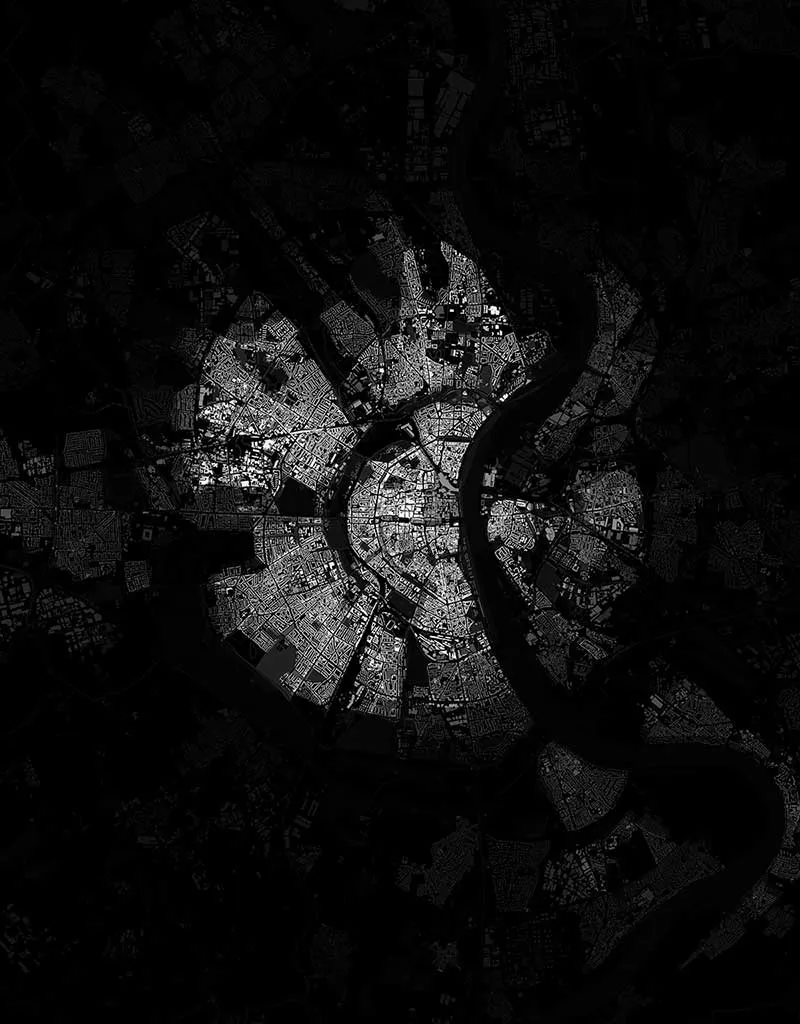
My master’s thesis at KISD — Köln International School of Design at TH Köln examines how on-demand service companies profoundly change urban space. Based on design-ethnographic analyses in Cologne, it explores new forms of algorithmic organisation, control, and surveillance of urban labour and mobility, and points to the precarious living and working conditions of solo self-employed platform workers. Building on this, it sketches the outlines of an emerging “city on demand”.
The progressive digitalisation of city and society is bringing about fundamental changes in urban space. A growing number of on-demand service companies — groceries delivered in ten minutes, ride hailing on demand, e-scooters across the entire city — operate in the physical fabric and in the virtual sphere of the city alike, and thereby change how urban space is perceived, used, and shaped. The ever-growing demand for, and availability of, goods and services at any place and at any time increasingly determines who works in the city and how that work is done, who moves through public space and in what manner, and which areas are accessible to whom.
The infrastructure through which these companies operate in the city is generally not perceived as urban infrastructure: delivery vehicles count as temporary obstacles, and warehouses, waiting positions, and routes go unrecorded in the official geography. How do on-demand service companies appropriate urban space, how do they act upon it physically and virtually alike, and how do they thereby change the perception and constitution of the city?
I pursued these questions through mapping techniques and (photo-)graphic analyses: routes, warehouse locations, waiting positions, and traces of movement are laid over the city map until, beneath the official geography, that of the platforms comes into view. One street section was also documented in a series of stills taken at 60-second intervals over the course of a day, so that the presence of delivery vehicles becomes legible as urban infrastructure in motion.
The thesis shows that on-demand providers make urban space an integral part of their own corporate infrastructure, and that the experience of urban realities increasingly depends on the use of digital on-demand services. Access to these services is restricted: only those with the necessary hardware and software and with sufficient financial means can make use of e-scooters or delivery services. At the same time the companies draw considerable benefit from public space and turn it into an exclusive delivery and distribution zone. Public space is repurposed as a value-creation platform and, from the service companies’ point of view, exists only as a function of the time it takes to travel through it.
The thesis ultimately leads to the question of resistant practices against the progressive on-demandisation of the city and explores possibilities for a participatory and common-good-oriented service policy for the city.
The thesis concluded my master’s studies and was written in the context of KISD’s Echtzeitstadt research unit, supervised by Prof. Dr. Carolin Höfler and Prof. Dr. Lasse Scherffig in the fields of design theory and research as well as interaction design.
Shown at: KISD Parcours 2022 · German Design Award 2022 (nomination)